|
German
Operations Orders
The
following article was written by Lou Brown and originally printed in Volume IV, Number 5
(Sep-Oct 1994) of Kettenhunde, the newsletter of a re-enactment group in the
northern United States who portrayed Feldgendarmerie-Trupp (Mot.) 200. Some sections
have been rewritten by the webmaster.
In "war movies," battle plans are usually
laid out by the hero in a half minute of generalized pontification followed by the
memorable phrase: "You all know what we have to do, now let's go do it."
In real life, the truth is that everyone doesn't know what to do, and a mechanism for
telling them what to do, as well as when (and, to some extent, how) is very necessary for
effective fighting. Modern armies utilize the "field operations order" as
an effective method of ensuring the coordination necessary for effective fighting.
A derivative of Napoleon's field
orders, the modern operations order contains those elements of information necessary to
synchronize and conduct the fight. The German approach to operations having been
somewhat "individualistic" (ie, the subordinate was expected to achieve the
mission given to him in his own way), German operations orders tend to be somewhat less
structured that those used in the US Army. Somewhere in the order, the following
elements (considered the minimum necessary for the conduct of operations) were supposed to
be addressed:
Often, "full" orders
were not necessary (eg, when updating or slightly changing a mission). The
organization of the partial order (called a FRAGO -- fragmentary order -- in US usage) is
the same, except that elements are omitted which either have not changed or are not
necessary to the order.
The operations order was
accompanied by a "Schema" (diagram, in English). In English, this is now
referred to as an "overlay" because it is drawn on a transparent substance and
"laid over" the map. The Schema shows, at a minimum, the graphic measures
used to control operations (eg unit boundaries, objectives, etc.) as well as known or
suspected enemy positions.
Operations orders under field
conditions are generally given orally (following the format) at battalion level and below
and in writing at regiment/brigade and above (written orders are nonetheless
"briefed" to those receiving the order if circumstances permit). Orders
can be written at any level if time permits, often if only to aid the commander in orally
delivering it.
What follows - in the format in
which it was written - is a translation of an operations order written by Oberleutnant
Georg Michael, a company commander in Schützen Regiment 26 for a dismounted attack in the
USSR on 28 June 1942. (This regiment was part of the 24th Panzer Division, famous
for having been formed from the 1st Cavalry Division. The Schützen regiments were
the motorized infantry component of the panzer divisions, and between late 1942 and early
1943 would be renamed as Panzergrenadier regiments. The 24th Panzer Division, with
its "leaping horseman" for a divisional emblem, would be destroyed in the
fighting at Stalingrad in the seven months following the attack described here).
As a unit with cavalry
traditions, Michael's regiment was divided into Squadrons rather than Companies, though
there was no real distinction in terms of equipment or organization other than the name.
Despite only being a set of Squadron orders, Michael still wrote them out, probably
simply because he had the time to do so.
Explanatory notes follow the
translation of the order itself and are indicated in the text by superscript numerals.
Oberleutnant Michael
was awarded the
Knight's Cross on 19 January 1941 and the Oakleaves to the Knight's Cross on 25 January
1943 for actions in Stalingrad, where he was critically wounded and evacuated. He
had been promoted to Rittmeister (Hauptmann of a cavalry unit) on 1 December 1942.
The action described below did
not go exactly as planned - they never do. The most important part of planning is,
however, ensuring that everyone understands the mission. While Michael's plan did
not unfold as he envisioned it in the order, he and his company nonetheless achieved the
objectives assigned them and, thus, fulfilled the intent of the order.
Military operations, contrary to
popular conceptions, don't just happen.
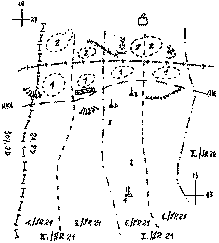
Sample Map Diagram
Below is a sample map diagram - this is not the
diagram that would have accompanied Michael's operations order, given below, but shows
what a typical German diagram may have looked like, using period map symbols.
|

|
 |
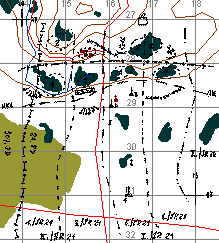
These crosses show how the "overlay" is
aligned with the map; the numbers refer to gridlines and the crosses are lined up overtop
of the intersection of these gridlines. |
|
|
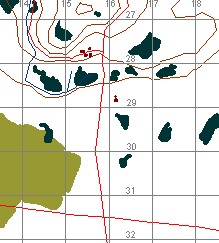
| At right is a graphical representation of
the Schema shown above. |

|
|
6./Schützen Regiment 26
Squadron Command Post, 24 Jun 1942
ORDER FOR THE ATTACK AFTER ASSEMBLY
ON "G-DAY"
| Maps 1 |
|
1:50,000 Schtschcigry, Pokrowskoje |
|
|
1:100,000 Kursk, Tim |
|
|
1:300,000 Stary Oskol |
|
|
|
| 1. |
Enemy: oral briefing on field fortifications with
"Flanders Walls" and bunkers using the enemy overlay. No mines have been
identified.
|
| 2. |
II/SR 26: 2
a) coordinated on both flanks, attacks enemy to the west of and in Truchatscheka at
morning twilight (G-Day and X-Hour to be announced) from assembly area east of Ssemenowka
under supporting fire of all heavy weapons to secure, with the first objective, the
southern approach to Truchatschewka and the second objective, Nordhang 247.7 north of
Petrischtschewa.b) Axes of advance on order.
Report according to map 1:100,000. Use compasses to avoid misorientation.
Compass bearings on order.
Sunset 19.50-20.45
Sunrise 2.20-3.15
c) Right neighbor I./SR 26
Left neighbor II./SR 21
d) Attached to the battalion:3
9.(sIG)/SR 26
1 platoon of
assault guns
3 demolition teams 2./PzPi 40
Support through
I./AR 89
1 mortar battery
1 battery Heavy Projector Rgt. 2
ground support aircraft
combat aircraft
e) commence fire at X-hour (to be announced)
f) next battalion command post location is in the ravine by
ruins, thereafter possibly following behind 6th Company
|
| 3. |
6th Company is on the battalion's right flank next to 5th
Company (7th Company in reserve) 4
attached 2 demolition teams 2./40
1 assault gun platoon (2 armoured vehicles) for the 1st objective
one mine sweeping team from 8th Company
1 forward observer I./AR 89
1 platoon leIG 8th Company1st
Objective: crossroads with bunker
2nd Objective: southern approach to Truchatschewka
|
| 4. |
Assembly for attack:5
a) At 22.00 on "G-1" Brakebusch platoon and a heavy MG platoon and one
demolition team, moving with combat reconnaissance in depth, reach the forward boundary of
the assembly area and organize outposts and dig in with
heavy MG squad Hilmer right
heavy MG squad Lichte left
In the event of a Russian attack, prevent enemy penetration into the assembly area.
b) The remainder of the company, in order
company headquarters and communications with forward observer and
minesweeping team
Löhrke platoon (assault platoon) with one demo team
Lt. Keiler platoon (reserve platoon) and 2 heavy mortars
heavy antitank riflesafter
closing by 23.00, dig in, in deep-arrayed attack formation (beside or behind each other on
verbal order).
|
| 5. |
Security of the assembly area by heavy weapons and
artillery already in place there
|
| 6. |
Course of the attack:6
| X-hour |
Divisional artillery preparation |
| X to X+4 minutes |
Mortars on bunkers and positions to 6th Company's front |
| X and 1 to X+1-1/2 minutes |
1 battery of heavy projectors on obstacles in front of 5th
company |
| X until X+4 minutes |
2 batteries III./AR 89 on enemy to 6th company's front |
| X + 1-1/2 minute |
Brakebusch platoon begins combat reconnaissance
Tasks:
1. Where are obstacles?
2. Where is bunker?
3. Blow or breach the first obstacle |
| X+4 minutes |
Shift light artillery 100 metres
Shift heavy artillery 200 metres |
| X+5 minutes |
breakthrough
departure of assault gun platoon
employment of assault gun platoon
(Löhrke platoon) on order |
|
| 7. |
Company aid station in bunker by the ruins
Unteroffizier Donath in charge
a) deliver 10 blankets on G-1 at 19.00 7
b) platoons establish wounded nests
|
| 8. |
Primary vehicles
a) Krupp supply truck (ammunition)
Motorcycle w/sidecar (Obergefreiter Böhm)
Motorcycle w/sidecar (Obergefreiter Gettkant - medical vehicle)
direction: Unteroffizier Leder (coordinate with Oberwerkmeister (Maintenance
Supervisor) Fittkau)b) Empty vehicles
battalion leader Lt. von Quast
8
company leader Wachtmeister Berger
March order: armoured portions
I./SR 26
applicable vehicles of the tank regiment
remainder of I. Battalion with combat trains
remainder of II./SR 26 with combat trains
|
| 9. |
Illumination level V
9 Meaning of
pyrotechnic signals:
white - - we are here
shot in a specific direction - - there, enemy pocket of resistance
red - - enemy attacking, request artillery
green - - shift fires
violet or blue - - tank warning
whistling starshell - - gas alarm
|
| 10. |
Ammunition reserve: battalion
- in the ravine in the centre of sector. Is marked.
company - 6 carriers with mortar ammunition follow after attack begins
ammunition truck and motorcycle w/sidecar follow by bounds
|
| 11. |
Communications:
before attack begins, via wire to battalion
after attack begins, squad radio between foremost platoon and company headquarters,
Gustav device to battalion
|
| 12. |
Prisoner collection point:
Also graves registration at 1st bridge in Ssemonowka 10
|
| 13. |
Attack begins on order
|
|
Distribution: Commander
= 1
4 platoons = 4
Trains = 2
War Diary = 1
tot = 8
(signed) Michael
Oberleutnant and Schwadronschef
11 |
Footnotes
1. Specifying
maps is very important to ensuring that everyone is "playing off the same sheet of
music." It is very unpleasant to find that the overlay you have been given for
an operation doesn't "fit" the map you are using because they are different
scales.
2.
Standard convention in naming German units was for companies to be identified by arabic
numerals (1, 2, 3...), battalions to be identified by Roman numerals (I, II, III), and for
regiments to be identified by an abbreviation followed by arabic numbers (JR for Jäger
Regiment 23, etc.). Bear in mind that common practice in German handwriting
was to write "J" for both "I" and "J", when handwriting on
overlays and maps, thus JR would be used for both Infantry Regiment and Jäger Regiment..
This was only partially due to the German handwriting fonts used at the time, according to
which these two did not differ in shape but in position. This was taught in schools until
the 1950s. The other motive for this was to not confuse Roman letters, which of
course uses the capital 'I" very frequently.
Since the companies in a regiment were numbered consecutively
across the battalions, it was unnecessary to list both company and battalion number.
The I Battalion generally contained 1, 2, 3 and 4 Companies, II Battalion 5, 6, 7 and 8
Companies, and where present the III Battalion contained 9, 10, 11 and 12 Companies.
Therefore you would only need to designate the Fifth Company as 5./JR 23 or the Second
Battalion as II./JR 23.
Paragraph 2 gives an easily understood friendly situation;
who is on the flanks and what other "friendlies" are doing, as well as the
mission of the next higher headquarters in the chain of command. In the US Army it
is doctrine to provide the mission for the next two higher echelons - a
company order would therefore containg the mission for both the battalion and the
regiment. The second objective mentioned in para 2a, "Nordhang 247.7" is a
hill. The Germans identified hills by their elevation in metres. In Michael's
orders, the name "Nordhang" was an additional identifier assigned to the hill by
the Germans themselves.
3. Schützen regiments generally consisted of only two
battalions of infantry (1-8 companies) and a third battalion consisting of specialized
support weapons (infantry guns, mortars, anti-tank guns, anti-aircraft guns, etc.)
In this case, the 9th Company contained sIG, or "schwere Infanterie Geschütz" -
heavy Infantry Guns used. Support was also provided by divisional units, in
this case the Second Company of Panzer Pionier (Armoured Engineer) Battalion 40, and the
First Battalion of Artillery Regiment 89.
4.
In infantry/schützen regiments, every fourth company was a heavy
weapons company, equipped with mortars and machineguns to support the other three
companies of the battalion, hence no reference to the 8th Company - one can presume its
weapons would be covering the attack. The reference to light infantry guns (leIG)
probably refers to one guns from one of the regimental weapons companies.
5.
In paragraph 4, Michael explains how the company will get from their assembly area
to the attack position (the last covered and concealed position before "jumping
off." The occupation by Brakebusch's platoon affords security for the remainder
of the company's move, and the company digs in already arrayed in the attack formation.
The order of march prevents the confusion of everyone moving -- or trying to -- at
once.
6.
Paragraph 6 outlines Michael's "vision" of how the attack will go down.
The order is slim on actual details concerning how the action will be fought. This
is not unusual in orders to units which have worked together for some time; they develop
what almost amount to "plays" as one would find in a sports team ("just
like we did it the last time") which are executed depending on the situation's
similarity to others the unit has experienced. In this case, whatever attack
formation ordered in paragraph 4 placed the units where Michael wanted them and,
therefore, tells everything the unit needed to know about "how to fight."
The rest of the order addresses items which are not so "routine."
7.
Paragraph 7 is interesting in the order to each platoon to deliver 10 blankets to
the battalion aid station. Platoon medics set up "wounded nests," a place
to which wounded were evacuated to be administered first aid and either returned to the
fight or evacuated to the company aid station.
8.
Paragraph 8b is extremely interesting. Michael's company was motorized (only
the First Battalion was "armoured", that is to say, mounted in armoured
halftracks). Since the attack was dismounted, someone had to get the company's
vehicles married back up with the troops on the objective (as did the rest of the
battalion). The task was important enough for the battalion to assign a Leutnant to
take charge of and move the empty trucks. (Assignment of an officer was a sure sign
of something being important to the Germans; they didn't have a lot of them, and didn't
waste the ones they did have.)
9.
Paragraph 9 refers to the amount of illumination during hours of darkness.
This is extremely important to a night move. (The US Army uses a percentage, with a
moonless night generally about 10-20%; a full moon affords 70-100% illumination.) Given
the short night (para 2b) and time of year, one would expect that level V is fairly high.
The visibility ratings I through X in Roman numerals were
used (Arabic numbers 1-10 were used by the Navy, and in fact also often by the army
artillery) corresponding to the standard Meteorological scale in use at the time.
The scale was measured in nautical miles (seemeile or sm in German):
| X. |
25sm (about 50 kilometers) |
| IX. |
10 sm (about 20 km) |
| VIII. |
5sm (about 10 kilometers) |
| VII. |
2sm (about 4 kilometers) |
| VI. |
1sm (about 2 kilometers) |
| V. |
0.5sm (about a kilometer) |
| IV. |
500 metres |
| III. |
200 metres |
| II. |
50 metres |
| I. |
Anything less than 50 metres |
Coloured flares were common signalling devices
in the German Army and combat leaders carried small handheld flare guns for this purpose.
10.
The designation of the "1st bridge in Ssemonowka" as both a POW and
Killed in Action collection point is unusual; in the US Army, the two were generally not
mixed if for not other reason than to prevent POWs from seeing the effectiveness of their
actions. In the Canadian Army, the Company Sergeant Major was generally responsible
for POW collection and organizing his company headquarters troops into ensuring
ammunition, water, fuel and food flowed forward, and that prisoners and casualties of all
types flowed backwards and were properly tended to.
11.
The term "schwadronchef" was used similarly to "kompaniechef"
in non-mounted units. It designated an officer in command of a company/squadron.
If Michael had been only an acting or temporary commander, his title would be
"schwadronführer" or Squadron Leader. |
|
|
Aftermath
The German place names are difficult to
locate on postwar maps in Russian. The names translate as per the table
below, and the locations can be found on the 1954 U.S. Army Map Service
maps. This series is in 1:250,000 scale. The image below comes from
sheet NM 37-1 "KURSK".
| Place Name (German) |
Place Name (Russian) |
| Schtschcigry |
Shchigry |
|
Ssemenowka |
Semenovka |
|
Truchatscheka |
Trukhachevka |
| Petrischtschewa |
Petrishcheva |

The attack itself is described in Chapter 8
of Panzergrenadier Aces: German Mechanized Infantrymen in World War
II.
In a movement lasting three weeks, the
24. Panzer-Division had traveled from France through Upper Silesia
to Kiev, and from there to Kursk. On 27 June 1942, it had occupied
an assembly area near Schtschigri.
“And what are we doing in all this, Herr Oberleutnant?”
Oberwachtmeister Brackebusch asked one of the platoon leaders.
“At dawn tomorrow, our battalion (II./Schützen-Regiment 26) will
attack the enemy in Truchatschewka from our assembly area, here in
Ssemenowka. It will be supported by fires from all available heavy
weapons. Its first objective will be the southern entrance to
Truchatschewka-here-and its second the north slope of Hill 247.7
north of Petrischtschewa. That would be this point."
Georg Michael folded the map and continued:
"The 6th (Company) will advance on the (battalion)'s right. We have
to be on our toes at the first road we will cross. There is a
Russian bunker there. We move out at 2000 hours. Brackebusch's
platoon will take point, followed by the heavy machine-gun platoon
with a demolition team. Reconnaissance-in-force ahead of the
advance, deployed depth, with Hilmer's heavy machine-gun section on
the right and Lichte's section on the left. That is all. Get ready!"
The 6th Company began moving at 2000hrs on
28 June with movement masked by the sound of a Ju 52 transport plane
circling above and despite a brief Russian barrage reached their
assembly point at 2200hrs. The German barrage began at 0200hrs, and the
attack began when the guns ceased fire. The company reached the enemy
barbed wire in good order and breached it quickly. Michael was hit in
the thigh by a bullet at this point, but was reluctant to abandon his
men and forced himself to keep moving forward. He joined Brakebusch's
platoon and occupied the first Russian trench where many dead were strewn
about and a few prisoners were taken.
Despite the darkness, large numbers of
Russians were spotted behind the platoon, apparently mistaking the
Germans for their comrades. They too were brought under fire and many
soon surrendered, while some had to be shot down when one of their
number reached for a hidden grenade.
With the first trench taken, Michael called
Obergefreiter Gettkant over to bandage his thigh. The medic insisted
that Michael accompany him back to the aid station, but Michael refused
and instead fashioned a crutch from a piece of trench revetting.
As the company prepared to resume the
attack, three hundred ground support aircraft arrived, and Stukas
attacked the second line of trenches. Strafing runs by fighter-bombers
persuaded many Russians in the second line to break and run. Michael
ordered the company forward with Leutnant Keiler's reserve platoon
following behind. Keiler, too, insisted that Michael go back for medical
attention, but he refused and continued to limp at the head of the
company. It was already hot by 0900hrs when the company had penetrated
so deep into enemy territory that they captured a Russian divisional
command post. They had moved 20 kilometres and approached the Tim River.
Tanks and engineers surged forward to seize
and secure a bridge across the stream, and the 6th Company's trucks
arrived after the tanks. The advance continued throughout the day, and
the night, and finally stopped at dawn on 29 June. As it began to rain,
orders from corps instructed the 24th Division to dig defensive
positions on the ground they occupied.
The 6th Company had suffered just two killed
and 11 wounded, while capturing seven guns and over 100 prisoners.
References
Kurowski, Franz. Panzergrenadier Aces:
German Mechanized Infantrymen in World War II. Stackpole Books,
Mechanicsburg, PA, 2010. ISBN 978-0-8117-0656-8
|